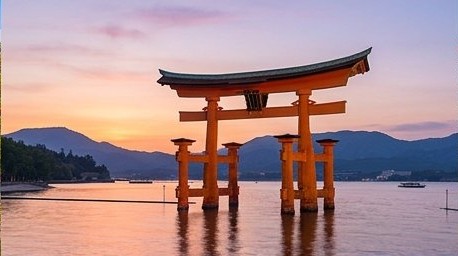
There is an image of Japan that appears on postcards, travel posters, and the dreams of would-be visitors the world over: a great vermilion gate standing alone in the sea, the mountains of an island rising behind it, the whole thing seeming to float weightless on the water. That gate belongs to Itsukushima Shrine on the island of Miyajima — and seeing it in person, at the right moment, is one of the most quietly breathtaking experiences in all of Japan.
But the floating torii is more than a pretty picture. Behind it lies a thousand years of belief, a clever solution to a sacred problem, and a rhythm set not by clocks but by the tides. As a licensed guide, I always tell visitors: Miyajima rewards those who understand it. Here is everything you need.
Why Is the Gate in the Sea? The Sacred Reason島そのものが神 ・ 海上社殿の理由
Most visitors assume the gate was built over water simply because it looks beautiful. The real reason is far more profound.
In ancient times, the entire island of Miyajima was considered a kami — a god in itself, so utterly sacred that ordinary people were not permitted to set foot on its soil for fear of defiling holy ground. So when the shrine was built along the shoreline, and its great torii gate placed out in the sea, it served a spiritual purpose: pilgrims would approach by boat, passing through the offshore gate and arriving at the shrine without ever treading on the sacred island itself. The water was the threshold. The gate marked the boundary between the ordinary world and the divine.
That is why Itsukushima Shrine and its torii are built on stilts above the sea, connected by wooden boardwalks — so the structures hover over the tideline rather than resting on hallowed earth. It's one of the only shrine complexes in Japan designed this way, and once you know the reason, the "floating" effect stops being a gimmick and becomes deeply moving.
Taira no Kiyomori and a Thousand Years of History平清盛と平安の美意識
Miyajima was worshipped as a holy site as far back as the 6th century, but the shrine took its iconic form thanks to one man. In 1168, Taira no Kiyomori — the most powerful figure in Japan at the close of the Heian period — chose the island as his clan's family shrine and built Itsukushima Shrine into the elegant, sea-spanning complex we recognize today. Its graceful vermilion halls, prayer hall, and over-water Noh stage reflect the refined aristocratic aesthetic of that age.
The shrine has been rebuilt and repaired many times over the centuries, always faithful to its original design. In 1996 it was inscribed as a UNESCO World Heritage Site, and it stands as one of Japan's official "Three Great Views" (Nihon Sankei).
The Great Torii: 60 Tons, Standing on Its Own Weight大鳥居 ・ 六十トンの工学美
The Great Torii is an engineering marvel disguised as a postcard. The current gate dates to 1875, standing roughly 16.6 meters (about 54 feet) tall — and here is the astonishing part: it is not anchored into the seabed at all. The massive camphor-wood pillars simply rest on the seafloor, held in place by the gate's own immense weight, estimated at around 60 tons, aided by clever construction (the top beam is even packed with stones for ballast). It has withstood centuries of tides and typhoons by sheer mass and ingenuity.
Like the shrine's floorboards, the structure relies on sophisticated interlocking joinery rather than nails — traditional Japanese carpentry at its finest.
Timing Is Everything: High Tide vs. Low Tide満潮と干潮 ・ 二つの顔
Here's the single most important piece of planning advice, and the thing casual visitors most often get wrong: Itsukushima is a completely different experience depending on the tide. Check a tide table before you go.
At high tide, the sea rises around the gate and beneath the shrine, and both appear to float on the water. This is the iconic, postcard view — the one you've seen in photos. Best for photography and that magical "floating" impression.
At low tide, the water drains from the bay, exposing the sandy seabed. You can walk right out across the flats to the base of the Great Torii and stand beneath it, appreciating its true scale up close. Low tide also reveals the Kagami-no-Ike (Mirror Pools), freshwater springs within the shrine grounds that never run dry even surrounded by seawater.
Neither is "better" — they're two different gifts. If your schedule allows, try to see both. And consider staying overnight: by day Miyajima is crowded, but in the evening, when the day-trippers leave and the shrine is illuminated, the island becomes hushed and otherworldly.
Practical Guide for Visitors実践ガイド
- Getting there
- Easier than you'd think. From Hiroshima, take the JR Sanyo Line (or the Hiroden streetcar) to Miyajimaguchi, then a roughly 10-minute ferry across to the island. The shrine is about a 10-minute walk from the ferry pier along the waterfront. The JR ferry is covered by the Japan Rail Pass.
- Cost and hours
- The shrine charges a modest entry fee and is generally open daily from around 6:30 am, with closing times shifting by season (roughly 5:00–6:00 pm). Early morning means fewer crowds and softer light.
- While you're there
- Meet the friendly wild deer that roam the island (like Nara, they're considered special here — please don't feed them). Take the ropeway up Mount Misen for sweeping views over the Seto Inland Sea, try the local momiji manjū (maple-leaf-shaped cakes) and grilled oysters, and stroll the old shopping street.
- A heads-up
- The Great Torii periodically undergoes restoration and may be covered in scaffolding — it's worth checking the shrine's current status before you travel if the floating-gate photo is your main goal.
- Etiquette & keepsakes
- For a refresher on how to worship at a Shinto shrine, see our Shrine vs Temple Guide. And our Goshuin Guide explains how to receive the hand-brushed stamp that makes a lasting memento.
Frequently Asked Questionsよくあるご質問
Why is the torii gate built in the sea?
Can you walk to the floating torii gate?
How tall is the Great Torii, and is it anchored?
Who built Itsukushima Shrine?
How do I get to Miyajima, and how much does it cost?
Should I visit at high tide or low tide?
The Gate Between Two Worldsむすびに
Itsukushima Shrine endures because it is more than beautiful — it is meaningful. The floating torii is not a decoration but a doorway, marking the line between the everyday and the sacred, rising and falling with the sea twice a day as it has for over eight centuries. Stand before it at high tide and it drifts like a dream; walk beneath it at low tide and feel its solid, towering weight. Either way, you're standing where pilgrims have stood for a thousand years.
When you're ready to plan a route through Japan's most beautiful shrines, the sacred sites we cover throughout Sacred Japan will help you find the way.
The gate that rises and falls with the tide — Itsukushima, where the world meets the sea.