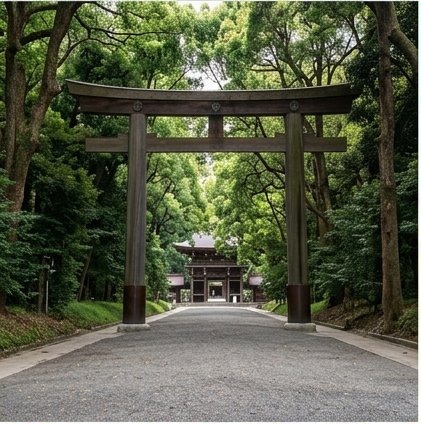
Step off the train at Harajuku, walk past the fashion boutiques and the weekend crowds, and turn into a forest. Within seconds, the city vanishes. The air changes. The noise falls away. You are walking beneath ancient-looking trees on a wide gravel path toward one of Japan's most important shrines — and yet you are still in the middle of Tokyo.
This is Meiji Jingu, and its greatest trick is also its deepest truth: the forest that feels so primeval, so eternal, was planted by human hands just over a hundred years ago. Understanding how and why tells you everything about the shrine, the emperor it honors, and the Japan he helped create.
The Emperor Who Changed Everything明治天皇と近代日本
Meiji Jingu is dedicated to Emperor Meiji (1852–1912) and his consort, Empress Shoken (1850–1914) — the couple who presided over one of the most dramatic transformations in any nation's history.
When Emperor Meiji ascended the throne in 1868, Japan had been closed to the outside world for over two centuries, ruled by samurai and governed by feudal lords. By the time of his death in 1912, Japan had a western-style constitution, a modern navy, a railway system, a public school network, and had won wars against both China and Russia. The Meiji Restoration — named for his reign — compressed two centuries of industrial and political change into a single generation.
It was also a period of wrenching cultural negotiation: how much of Japan's identity to preserve, and how much to transform. Emperor Meiji navigated this with genuine thoughtfulness, and that complexity is visible in a small but telling detail at the shrine built in his memory: along the inner approach, rows of traditional sake barrels donated by breweries from across Japan stand alongside rows of Burgundy wine barrels from France. Both are offerings to the deity. Both reflect the man: deeply rooted in Japanese tradition, and genuinely open to the world.
The shrine was completed in 1920, eight years after the emperor's death, built through the devotion of citizens who wanted to honor him. It was destroyed in the wartime bombing of 1945 and rebuilt in 1958, faithfully restored through nationwide donations — a second act of collective reverence.
The Forest That Was Designed to Forget Itself永遠のために設計された杜
When the site was chosen in 1915, the land was largely barren — a vegetable garden and an iris field. A team of forestry experts was given an extraordinary brief: design a sacred forest intended to last forever, requiring no maintenance once established, that would feel natural rather than cultivated.
Their solution was ecological genius. Rather than planting showy ornamental trees that would need constant care, they chose primarily evergreen broadleaf species — oak, camphor, zelkova — that would compete naturally, shade out weaker plants, create their own soil, and ultimately form a self-sustaining woodland. They mapped out four phases of fifty years each, knowing the forest would not reach its intended state within any planner's lifetime.
Around 100,000 trees were donated from every corner of Japan, and 110,000 young volunteers planted them. The forest was declared complete in 1920 along with the shrine, and then — deliberately — left alone. No pruning, no planting, no clearing. When a tree falls, it stays where it fell, returning to the earth. The forest has been governing itself ever since.
A century later, it has become exactly what its designers intended: a 70-hectare woodland in the heart of Tokyo that most visitors assume is ancient. Knowing this, the walk through it takes on a different meaning.
What to See: The Inner Shrine Approach参道と見どころ
The main approach from the south entrance — the one most visitors use, nearest Harajuku Station — runs for about a kilometer through the forest to the main shrine complex. Walk it slowly.
The Great Torii Gate: Near the south entrance stands one of Japan's largest wooden torii gates — roughly 12 meters tall, made from a single aged cypress. A photograph here is almost obligatory, but pause a moment before walking through: this is the threshold between the everyday world and the sacred.
The Sake and Wine Barrels: Just inside the inner precinct, look for the rows of cedar sake barrels (kazaridaru) stacked against the wall on one side — and the wine barrels from Burgundy on the other. Few visitors understand what they're seeing. This small detail says more about the Meiji era than any textbook.
The Main Shrine (Honden): The main hall is built in nagare-zukuri style from Japanese cypress, understated and beautiful. You can often witness traditional Shinto wedding processions passing through — the white kimono of the bride and the formal court dress of the groom against the deep green of the forest are unforgettable.
The Married Couple Camphors (Meoto Kusunoki): Near the main hall, two enormous camphor trees grow side by side, their branches reaching toward each other. They are said to embody the bond between Emperor Meiji and Empress Shoken, and are believed to bring blessings for relationships.
The Inner Garden (Naien): A short detour from the main approach leads to the iris garden, which blooms magnificently in June — a tribute to Empress Shoken's love of the flower. The garden also contains Kiyomasa's Well, a natural spring used for purification.
Hatsumode: Three Million People at New Year初詣 ・ 三百万人の参拝
If you are in Tokyo for the New Year, Meiji Jingu is the place to experience hatsumode — Japan's tradition of making the first shrine visit of the year to pray for health, good fortune, and success. In the first three days of January, roughly three million people make the pilgrimage here, making it the most visited shrine in Japan for hatsumode.
The mood is communal and festive: food stalls, paper fortunes (omikuji), charm booths, and the quiet prayer of millions of people standing in the cold at the turning of the year. Even if you have to queue, it is one of the most authentically Japanese experiences Tokyo can offer.
Practical Guide for Visitors実践ガイド
- Getting there
- Meiji Jingu is one of the easiest major shrines in Japan to reach. The south entrance is a 5-minute walk from Harajuku Station (JR Yamanote Line) and about 5 minutes from Meiji-jingumae Station (Tokyo Metro Chiyoda and Fukutoshin lines). The north entrance is near Yoyogi Station and Sangubashi Station.
- Hours and cost
- The inner shrine grounds are open from sunrise to sunset, every day of the year, and entry is free. The Inner Garden (iris garden) charges a small admission fee.
- How long to allow
- The walk in from the south entrance to the main shrine takes about 10 minutes at an easy pace — longer if you stop to appreciate the forest. Allow 1 to 1.5 hours for a full visit including the Inner Garden.
- Combine with
- Meiji Jingu pairs beautifully with the surrounding area. Yoyogi Park (directly adjacent, free) is perfect for a picnic. The Harajuku shopping street and Omotesando are a short walk away. The Meiji Jingu Museum, beside the inner precinct, holds personal artifacts of the Emperor and Empress.
- Etiquette & keepsakes
- If you'd like a guide to shrine worship before you visit, our Shrine vs Temple Guide explains how to bow, purify, and pray. For collecting the hand-brushed stamp that makes a lasting memento, see our Goshuin Guide.
Frequently Asked Questionsよくあるご質問
Who is enshrined at Meiji Jingu?
Is the forest at Meiji Jingu natural?
What are the sake and wine barrels for?
How many people visit for hatsumode (New Year)?
How do I get to Meiji Jingu, and is it free?
When is the best time to visit?
A Forest Built to Last Foreverむすびに
Meiji Jingu is where Tokyo's relentless energy encounters something it cannot move: a century-old forest planted to outlast any individual human plan, a shrine rebuilt twice from collective devotion, and the memory of an emperor who held Japan's past and future in the same hands. Come for the quiet of the trees; leave with a sense of the scale of what Japan has navigated — and what it has chosen to remember.
When you're ready to explore more of Japan's most meaningful sacred sites, the shrines we cover throughout Sacred Japan will help you find the way.
A hundred-year forest, a shrine rebuilt twice — Meiji Jingu, Tokyo's sacred heart.