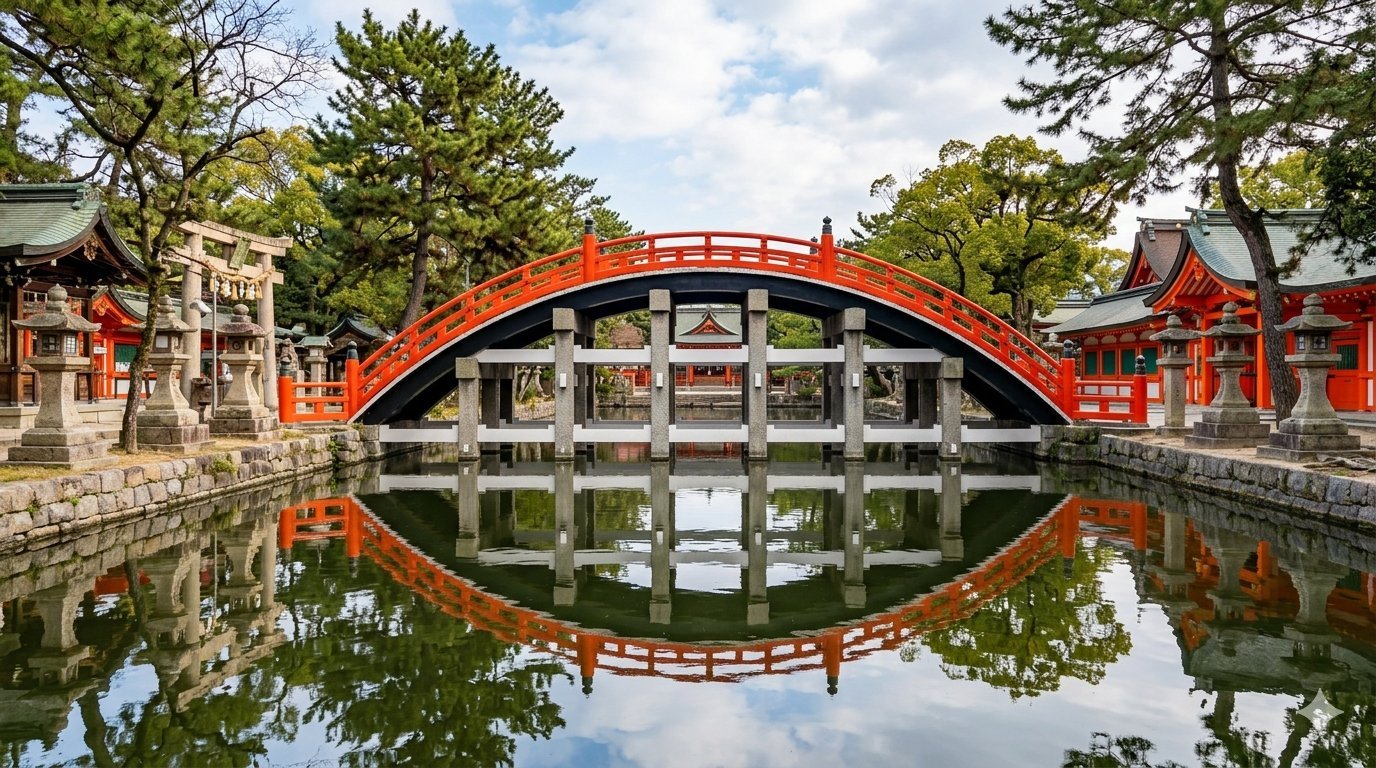
Cross the steep vermilion bridge that arches over the pond at the entrance to Sumiyoshi Taisha, and you are doing something pilgrims have done for over a thousand years: not just walking, but purifying yourself, leaving the ordinary world behind with each step up and over. On the far side stands one of the oldest and most important shrines in all of Japan — and one that looks unlike almost any other you will visit.
While Kyoto's shrines dazzle with ornament and Nikko overwhelms with gold, Sumiyoshi Taisha is something rarer: a window into what Japanese sacred architecture looked like before Buddhism and Chinese design ever reached these shores. As a licensed guide, I bring people here precisely because it feels ancient in a way few places do. Here is everything you need to understand it.
The Head Shrine of the Sea Gods海の神の総本社
Sumiyoshi Taisha is the grand head shrine of around 2,300 Sumiyoshi shrines scattered across Japan — a network of branch shrines that gives you a sense of its importance. Its traditional founding date is given as 211 AD, over 1,800 years ago, placing it among the very oldest Shinto shrines in the country.
It enshrines the Sumiyoshi Sanjin — three sea deities — together with Empress Jingu, the legendary empress-regent said to have founded the shrine. According to the ancient Kojiki chronicle, these three gods guided Empress Jingu's fleet safely across the sea during a legendary naval expedition, and in gratitude she enshrined them here. From that moment, the Sumiyoshi deities became the great protectors of seafarers, fishermen, and maritime trade.
This was no minor role. Osaka was Japan's principal port and its commercial gateway to the Asian continent for centuries, so the shrine that protected sailors and sea routes sat at the heart of the nation's prosperity. Today people still come to pray for safe travel, success in business, and protection of the home — and around two million visit in the first three days of January for hatsumode, the New Year's first prayer.
Sumiyoshi-zukuri: Architecture From Before Buddhism住吉造 / 仏教以前の様式
Here is what makes Sumiyoshi Taisha genuinely special, and the thing most visitors walk past without realizing. The four main halls are built in a style found almost nowhere else: Sumiyoshi-zukuri, one of the oldest shrine architectural styles in Japan, and a National Treasure.
To appreciate why this matters, a little context. Most of the famous shrines and temples travelers see in Japan were shaped — directly or indirectly — by Buddhism and Chinese design, which arrived from the 6th century onward, bringing curved roofs, elaborate brackets, and ornamentation. But a handful of shrine styles preserve the purely native Japanese aesthetic from before those influences. Ise Grand Shrine's shinmei-zukuri is one; Sumiyoshi's sumiyoshi-zukuri is another, and even more archaic in feeling.
What you'll notice: straight, bold rooflines rather than graceful curves; a striking contrast of bright vermilion pillars against white walls; forked finials (chigi) and short logs (katsuogi) along the ridge; and a clean, almost severe purity of form that prioritizes structure over decoration. The four halls are arranged in an unusual layout — three in a line, one beside the third — said to evoke a fleet of ships at sea, fitting for the gods of the ocean.
If you've read our Ise Grand Shrine guide, Sumiyoshi makes a fascinating companion: two of Japan's oldest, most purely native architectural styles, both preserving a vision of the sacred from the dawn of Japanese civilization.
The Sorihashi: The Bridge That Purifies You反橋 / 心を清める橋
The shrine's most photographed feature is the Sorihashi, also called the Taiko-bashi ("drum bridge") for its shape. This dramatically steep, bright red arched bridge curves over a sacred pond at the entrance — and its reflection in the water below is one of Osaka's most beautiful sights, especially in soft morning light or cherry blossom season.
But the bridge is more than a photo spot. Crossing it prepares the worshipper to approach the gods. Take it slowly — the climb is steeper than it looks — and treat the crossing as the beginning of your visit, not just a way across the water.
Other Highlights見どころ
The Couple Camphor and the Thousand-Year Camphor. Among the giant camphor trees on the grounds, two are special. The Meotogusu ("Couple Camphor") has two trunks merged into one — about 800 years old and 19.5 meters tall — and is revered as a symbol of marital harmony and good relationships. The Sennengusu ("Thousand-Year Camphor") is, true to its name, over a millennium old.
The rabbit motif. Look for rabbit statues and imagery around the shrine. The shrine's founding is associated with the u (rabbit) day of the u month, and the rabbit has become a beloved symbol here — even some of the omikuji fortunes come tucked inside little ceramic rabbits.
The Sumiyoshi Festival. At the end of July and start of August, the shrine holds Osaka's great summer purification festival, including the Nagoshi no Harae ritual where worshippers pass through a large ring of woven grass (chinowa) to cleanse the impurities of the past half-year. On August 1, a mikoshi carrying the Sumiyoshi deity crosses the arched bridge and the Yamato River — a striking sight.
Practical Guide for Visitors実践ガイド
- Getting there
- Sumiyoshi Taisha is easy to reach and pleasantly off the typical tourist track. The most charming way is the Hankai Tramway, Osaka's vintage streetcar — get off at Sumiyoshi-toriimae, right in front of the shrine. Alternatively, Sumiyoshitaisha Station on the Nankai Main Line is a few minutes' walk. It's only about 10-15 minutes south of central Namba.
- Cost and hours
- Entry is free. The shrine generally opens early (around 6:00-6:30 am) and closes in the late afternoon (around 4:00-5:00 pm). Early morning is the most peaceful and the best light for the bridge.
- How long to allow
- About an hour is comfortable — time to cross the bridge and enjoy the pond garden, explore the four National Treasure halls, find the camphor trees and rabbit statues, and visit the sub-shrines. History and architecture enthusiasts could easily spend two hours.
- Tip
- Combine your visit with a ride on the Hankai Tramway for a nostalgic half-day, and pair it with nearby Sumiyoshi Park for a stroll.
- Etiquette & keepsakes
- For a refresher on shrine worship before you go, see our Shrine vs Temple Guide. And our Goshuin Guide explains how to receive the hand-brushed stamp that makes a meaningful memento.
Frequently Asked Questionsよくあるご質問
What is Sumiyoshi Taisha famous for?
What makes Sumiyoshi-zukuri architecture special?
Why is the arched bridge so steep, and should I cross it?
Which deities are enshrined at Sumiyoshi Taisha?
How do I get to Sumiyoshi Taisha, and is it free?
When is the best time to visit?
A Glimpse of Japan's Beginningsむすびに
Sumiyoshi Taisha rewards the traveler who slows down. Cross the steep red bridge as a ritual rather than a photo op; stand before the four ancient halls and recognize that you're seeing a form of architecture older than almost anything else in Japan; remember that sailors once stood here praying to the same gods before setting out across dangerous seas. In a city famous for its food and its modern energy, Sumiyoshi Taisha offers something Osaka rarely advertises: a direct, living link to the very beginnings of Japanese spiritual life.
When you're ready to plan a journey through Japan's most ancient and beautiful shrines, the sacred sites we cover throughout Sacred Japan will help you find the way.
Ancient, vermilion, eternal — Sumiyoshi Taisha, the sea gods' shrine.