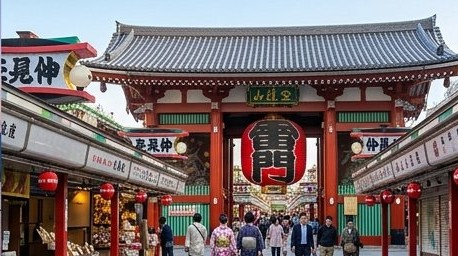
Walk through the great red Thunder Gate at Asakusa, beneath a paper lantern the size of a small car, and you join a river of people that has been flowing toward this spot for nearly 1,400 years. Senso-ji is Tokyo's oldest temple, its most visited sacred site, and — with around 30 million visitors a year — quite possibly the most visited spiritual site on Earth. It is also, somehow, still a place of genuine devotion beneath all the bustle.
Most visitors pass through in an hour, snapping photos of the lantern and grabbing a snack on the shopping street. As a licensed guide, I think that's a shame, because Senso-ji rewards those who know what they're looking at. Behind the spectacle lies a 7th-century legend, a hidden golden deity no one is allowed to see, and a way of worship distinct from the shrines most visitors know. Here is everything you need.
The Legend: A Golden Kannon in a Fishing Net本尊・浅草観音の由来
Senso-ji's story begins in the year 628, on the Sumida River. According to tradition, two fisherman brothers, Hinokuma no Hamanari and Takenari, cast their nets and pulled up a small golden statue of Kannon — the Bodhisattva of Mercy and Compassion. They didn't recognize what it was and returned it to the river, but no matter how many times they cast their nets elsewhere, the statue kept returning to them.
The village headman, Hajino Nakatomo, recognized the figure as the sacred Kannon, converted his own home into a small temple, and devoted his life to worship. That humble beginning grew, over the centuries, into Senso-ji — and Kannon has been the temple's beloved principal deity ever since, which is why the temple is also affectionately known as Asakusa Kannon.
Here is the detail that gives the temple its mystery: that original golden Kannon statue is a hibutsu — a "hidden Buddha." It has never been shown to the public, and is not displayed even to the temple's own priests. What worshippers pray toward in the main hall is a substitute image, created in the 9th century precisely so people could direct their devotion while the true statue remained concealed. Like Japan's other most sacred objects, its power lies in being unseen.
Walking the Approach: Gate, Street, Gate, Hall参道を歩く
Senso-ji is designed as a journey, and walking it in order is part of the experience.
Kaminarimon (the Thunder Gate). The temple's iconic outer gate, and one of Tokyo's most famous landmarks. Its giant red lantern weighs around 700 kilograms and stands nearly four meters tall. The gate's full name, Furaijinmon, means "Gate of the Wind and Thunder Gods" — and indeed, statues of Fujin (wind) and Raijin (thunder) guard its two sides, protecting the temple from disaster. Look up at the bottom of the lantern for a beautiful carved dragon.
Nakamise-dori. Beyond the gate stretches a 250-meter shopping street that has served temple pilgrims since the Edo period. Around 90 shops sell traditional snacks and souvenirs — freshly grilled senbei crackers, ningyo-yaki cakes, folding fans, yukata. It's touristy, yes, but it's historically touristy: people have been snacking their way to this temple for over 300 years.
Hozomon (the Treasure House Gate). The grand inner gate, named for the Buddhist scriptures stored on its upper floor. Look at its rear and you'll find a pair of giant straw sandals, woven by villagers and offered as a symbol that protects the temple.
The Main Hall and Five-Story Pagoda. Beyond Hozomon stands the main hall housing Kannon, and a soaring five-story pagoda — one of Tokyo's classic silhouettes, its tiers representing the elements of Buddhist cosmology. Almost everything you see was rebuilt after 1945, when the temple was destroyed in the wartime bombing of Tokyo; its reconstruction became a symbol of the city's resilience and recovery.
How to Worship at a Temple (It's Different From a Shrine)お参りの作法
This trips up many visitors, so let me be clear: Senso-ji is a Buddhist temple, not a Shinto shrine, and the worship is different. Most importantly — you do not clap at a temple. (Clapping is for shrines.)
The temple way: first, pause and bow at the gate. Many visitors then waft the smoke from the large incense burner (jokoro) in front of the main hall over themselves — it's said to bring health and healing to the part of the body it touches. At the main hall, toss a coin gently into the offering box, bow, place your palms together in silent prayer (without clapping), and bow once more.
If you'd like the full explanation of the differences between temple and shrine worship, our Shrine vs Temple Guide covers it in detail — useful here, because the temple sits right beside a shrine (more on that next).
The Hidden Shrine Next Door — and Its Wild Festival浅草神社と三社祭
Here's something most visitors walk right past: tucked beside the great temple is Asakusa Shrine, a Shinto shrine dedicated to the three men from the founding legend — the two fishermen and the village headman who enshrined the Kannon. It's a beautiful example of Japan's long history of Shinto and Buddhism coexisting side by side.
That small shrine is also the home of one of Tokyo's wildest festivals: the Sanja Matsuri, held each May, when around two million people fill Asakusa and over a hundred portable shrines are carried through the streets by chanting bearers. If you want to understand the living, raucous side of Japanese faith, it's unforgettable. → Read more in our Japanese Festivals guide.
Practical Guide for Visitors実践ガイド
- Getting there
- Senso-ji is extremely easy to reach — about a 5-minute walk from Asakusa Station, served by the Tokyo Metro Ginza Line, the Toei Asakusa Line, and the Tobu Skytree Line. Asakusa Station connects directly to Ueno, Ginza, and both Narita and Haneda airports.
- Hours and cost
- Entry is free. The temple grounds are open 24 hours; the main hall is open roughly 6:00 am to 5:00 pm (from 6:30 am October–March). Nakamise shops and the amulet counters keep their own daytime hours.
- Best time to visit
- Early morning (before 8:00) is magical — the Nakamise shutters are still down or just opening, the crowds haven't arrived, and you can photograph the gates and pagoda in peace. Evening is also beautiful, when the gates and pagoda are illuminated. Avoid mid-day if you can; it is genuinely packed.
- While you're there
- Climb nothing — but do look up at the Tokyo Skytree, which rises dramatically behind the temple for a striking old-meets-new photo. Try a snack on Nakamise. Draw an omikuji fortune (Senso-ji is famous for being honest enough to still hand out "bad luck" slips — if you get one, tie it to the rack provided to leave the bad luck behind).
- A note on respect
- Despite the crowds and the festive atmosphere, this is an active place of worship for millions. Keep a respectful manner near the main hall, and avoid blocking worshippers for photos.
- Keepsakes
- Senso-ji is a wonderful place to receive a goshuin stamp — our Goshuin Guide explains how. The temple is also famous for its omamori charms; see our Omamori Guide.
Frequently Asked Questionsよくあるご質問
Why is Senso-ji famous?
What is the legend of Senso-ji's founding?
Is Senso-ji a shrine or a temple?
How do I get to Senso-ji and is it free?
What is the best time to visit Senso-ji?
What's the giant lantern at the Thunder Gate?
Where Old Tokyo Still Praysむすびに
Senso-ji is the beating heart of old Tokyo — a temple that has been pulled from a river, rebuilt from ashes, and visited by emperors, shoguns, and 30 million tourists a year, yet still hides a golden deity that no one will ever see. Come early, walk the approach in order, waft the incense, pray without clapping, and step into the quiet shrine next door. Do that, and Asakusa stops being a tourist stop and becomes what it has always been: the place where Tokyo goes to pray.
When you're ready to explore more of Japan's sacred sites, the shrines and temples we cover throughout Sacred Japan will help you find the way.
Pulled from a river, rebuilt from ashes — Senso-ji, where Tokyo goes to pray.