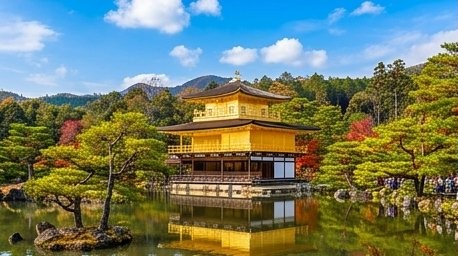
The building you are looking at is not the original. The three-story golden pavilion reflected in the mirror-still waters of Kyokochi Pond has stood for less than a century — and it exists because of an act of destruction that shocked all of Japan. That story, and the question it raises about why we seek to destroy what we find impossibly beautiful, gives Kinkaku-ji a depth that the photographs never quite capture.
As a licensed guide, I find that most visitors walk through in twenty minutes, take their photos from the one classic vantage point, and leave. I understand why — the view is extraordinary, and the temple was designed precisely to produce that effect. But there is much more here than a golden reflection. Here is everything you need to know.
A Shogun Who Collected Power the Way Others Collect Gold足利義満の野望
Kinkaku-ji was built in 1397 by Ashikaga Yoshimitsu, the third shogun of the Muromachi period — and perhaps the most powerful man Japan had ever seen. By the time he built this pavilion as his private retirement residence, Yoshimitsu had done something no Japanese leader had managed before: he had unified a country split between two rival imperial courts, consolidated the authority of the samurai government, established profitable trade with China, and received from the Chinese emperor the title "King of Japan." He was, in effect, ruler of the entire country.
The pavilion he built reflects that ambition in every detail. Each of its three floors is constructed in a different architectural style, deliberately chosen to represent the three sources of Japanese power:
The first floor is built in the aristocratic shinden-zukuri style of the Heian court — the style of the emperors and the ancient nobility.
The second floor uses the bukke-zukuri style of the samurai warriors — the military class that had come to rule.
The third floor is built in the karakyo-zukuri style of Chinese Zen Buddhism — the religious authority that legitimized both.
By stacking all three in a single building, covered in gold, Yoshimitsu was making a statement: all power flows through me. It is an act of architectural arrogance as breathtaking as the gilding itself. After Yoshimitsu's death in 1408, his son converted the villa into a Zen Buddhist temple, and it has remained one ever since — its official name is Rokuon-ji, though no one calls it that.
The Fire, the Novel, and What It Means to Destroy Beauty炎と美と自由と
On the morning of July 2, 1950, a 21-year-old novice monk named Hayashi Yoken set fire to the Golden Pavilion and attempted suicide alongside it. He survived. The pavilion — 555 years old, a national treasure — was reduced to ash within hours. A few precious items were saved; the famous golden phoenix that had crowned its roof had, by coincidence, been removed for repairs shortly before, making it the only surviving original element.
The monk's motivations were complex: a deep psychological obsession with the pavilion's beauty and a tortured sense that such perfect beauty was an affront to the world's imperfection. His trial became a national sensation.
Six years later, the novelist Yukio Mishima transformed the event into one of the masterpieces of 20th-century Japanese literature: The Temple of the Golden Pavilion (1956), told from the perspective of a fictionalized version of the monk. The novel is dark, gorgeous, and troubling — and reading it before a visit changes everything about how you see the pavilion.
The pavilion was rebuilt by 1955, meticulously faithful to the original design but sheathed in gold leaf five times thicker than before. What you see today is a new building aspiring to be its own ancestor — which is, in a sense, very Japanese.
What You're Actually Looking At境内を見る
The route through the temple grounds is a one-way circuit of a kaiyushiki (strolling) garden, and you see the pavilion from several angles — the classic reflection from the lakeside, closer views of the individual floors, and finally a tea house and the path to the exit.
The Kyokochi Pond (Mirror Pond) was designed so that the pavilion's reflection appears on the water in certain light conditions, effectively doubling the golden vision. The small islands dotted throughout the pond represent cranes and turtles — traditional symbols of longevity.
The phoenix on the roof. The gold phoenix perching on the very top of the third floor gazes south — toward the capital. It is the spiritual successor to the one lost in the 1950 fire; the original that survived (removed for repairs at the time) is now preserved safely.
The garden itself. Beyond the pavilion, the strolling garden contains Sekkatei tea house, a stone said to resemble Mount Fuji, and pathways through moss and pine. It rewards a slow walk.
What you cannot do: enter the pavilion. Like many of Japan's most sacred objects, it can be admired only from the outside. The interior is not open to visitors.
Kinkaku-ji and Ginkaku-ji: Gold and Silver, Power and Restraint金と銀
Kinkaku-ji has a counterpart that makes visiting both one of Kyoto's most rewarding experiences: Ginkaku-ji, the Silver Pavilion, built by Yoshimitsu's grandson Yoshimasa in the late 15th century.
The contrast could not be more complete. Kinkaku-ji is bold, golden, a statement of absolute power. Ginkaku-ji was never actually covered in silver — plans were abandoned, likely due to a combination of the Onin War, financial strain, and a shift in aesthetic values. What resulted instead is an unassuming wooden structure in a garden of raked sand and moss, austere in the way that only something that chose not to try can be. It embodies wabi-sabi — the Japanese aesthetic of beauty found in imperfection and incompleteness — in a way its golden counterpart never could.
Two temples, built by grandfather and grandson, one century apart. One chose to dazzle; one chose to whisper. Together they define the range of Japanese aesthetic possibility.
Practical Guide for Visitors実践ガイド
- Getting there
- From Kyoto Station, take city bus #205 to the Kinkakuji-michi stop (about 40 minutes). The Kintetsu Bus also runs a Kinkaku-ji express service. A taxi from the station takes about 25–30 minutes. Note that there is no nearby train station — buses are the main access.
- Hours and cost
- Open daily 9:00 am to 5:00 pm. Admission is ¥500 for adults. The grounds close promptly; arrive with time to complete the circuit.
- Best time to visit
- Early morning — right at the 9:00 am opening — gives you the fewest crowds. The pavilion is beautiful in every season: snow dusting the golden roof in winter is spectacular, as is the autumn foliage reflected in the pond. Midday and weekends are the most crowded.
- How long to allow
- About 30–45 minutes for the standard one-way circuit, or a full hour if you walk slowly and sit with the view.
- Combine with
- Ginkaku-ji (Silver Pavilion), Ryoan-ji (the famous rock garden), and Nijo Castle are all in the broader northwest Kyoto area and combine naturally with a Kinkaku-ji visit. Arashiyama's bamboo grove and Tenryu-ji are further west but doable in a full day.
- Etiquette
- For how to behave at a Buddhist temple, including the difference from shrine worship, see our Shrine vs Temple Guide. To collect the temple's hand-brushed stamp, see our Goshuin Guide.
Frequently Asked Questionsよくあるご質問
What is Kinkaku-ji famous for?
Is the Golden Pavilion real gold?
Why was Kinkaku-ji burned down?
What do the three floors of Kinkaku-ji represent?
Can I go inside Kinkaku-ji?
How do I get to Kinkaku-ji?
A Golden Thing That Was Made to Burnむすびに
Kinkaku-ji is not an ancient monument. It is a monument to loss, and to the stubborn human impulse to rebuild what was beautiful even after it is gone — perhaps more perfectly than before. Stand by the pond long enough to stop thinking about your photo and ask yourself what Yoshimitsu was trying to say with all that gold, what the young monk could not bear about it, and whether a building can be more powerful for having been destroyed. Those are the questions this extraordinary place keeps asking, quietly, across the centuries.
When you're ready to explore more of Kyoto's and Japan's most meaningful sacred sites, the guides throughout Sacred Japan will help you find the way.
A golden thing built by a man who held all power, burned by one who could not bear beauty, and rebuilt to outlast them both — Kinkaku-ji, where Kyoto's reflection never quite fades.