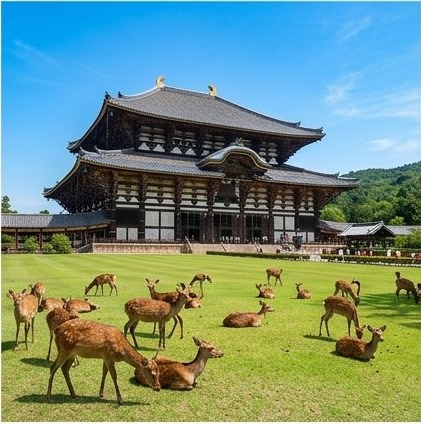
Before you see the Great Buddha of Nara, you see the building that contains it. The Daibutsuden — the Great Buddha Hall — appears first as a dark shape through the deer-dotted park, then grows larger and larger until you're standing before something so enormous that the mind struggles to make sense of it. It is the largest wooden structure in the world. And inside sits a bronze Buddha fourteen and a half meters tall, whose hand alone is larger than a full-grown human.
The sheer scale is the first thing. But as a licensed guide, I've learned that scale without context is just a measurement. What makes Todai-ji extraordinary is understanding why this building and this statue exist at all — why an 8th-century emperor decided to mobilize an entire nation to build the largest religious monument his era had ever seen. That story begins with catastrophe.
The Emperor Who Built a Buddha Out of Despair聖武天皇の祈り
In the 740s, Japan was unraveling. An epidemic of smallpox swept the country and killed an estimated one million people — possibly a third of the population. Crops failed. The powerful minister Fujiwara no Hirotsugu raised a rebellion in Kyushu. And Emperor Shomu watched his only son, the crown prince, die in infancy.
Shomu was a deeply religious man, and he responded to these catastrophes in the only way he knew: he turned to the Buddha. In 743, he made a vow to cast the world's largest gilt bronze statue of Vairocana — the cosmic Buddha who illuminates the universe — as a prayer for the nation's peace and his people's relief. He issued a call to every person in Japan to contribute, even a single blade of grass or handful of earth. Over 2.6 million people are said to have been involved in the construction.
It took a decade. The statue was completed and consecrated in 752, in a ceremony attended by ten thousand Buddhist monks — and presided over by an Indian monk named Bodhisena, who painted in the Great Buddha's eyes. That an Indian monk played the central ritual role at Japan's most important ceremony tells you something remarkable about how connected the 8th-century world already was.
Shomu himself attended the ceremony dressed in monk's robes rather than imperial regalia, and is recorded as declaring himself "a servant of the Three Treasures of Buddhism." The emperor of Japan, bowing before the Buddha he had built.
The Scale: How Big Is the Great Buddha?大仏の大きさ
Numbers alone don't convey it. The Great Buddha — officially the Rushana Butsu, or Vairocana Buddha — stands 14.7 meters tall, weighing over 250 tons of bronze, and was originally covered in gold. Here is what that means in human terms:
- The face alone is 5.3 meters tall
- Each eye is 1 meter wide
- Each ear is 2.5 meters long — the length of an adult lying flat
- The hand, resting open on the knee, is 2.4 meters across — large enough for a person to sit in
- The lotus petals on which the Buddha sits are each engraved with a detailed miniature universe
Stand before it, and the proportions quietly rearrange something in your sense of scale. The Great Buddha is not trying to be beautiful in the way a painting is beautiful. It is trying to be immeasurable — to give physical form to a presence too vast to comprehend.
The Hall: The World's Largest Wooden Building大仏殿
The Daibutsuden that houses the Great Buddha is itself a wonder. At roughly 57 meters wide, 50 meters deep, and 49 meters tall, it is recognized as the largest wooden building in the world — and remarkably, the current structure (rebuilt after fires in 1180 and 1567) is only two-thirds the size of the original. The original Daibutsuden was even more staggering.
Inside, besides the Great Buddha, stand two massive attendant figures — Nyoirin Kannon on the right and Kokuzo Bosatsu on the left — and models of the original temple's two great seven-story pagodas, which have been lost to history.
The Pillar With the Hole
Behind the Great Buddha, look for a large wooden pillar with a rectangular hole bored through its base. The hole is said to be the same size as the Great Buddha's nostril, and the tradition holds that those who can squeeze through it will receive the Buddha's wisdom and blessings in the next life. Watch Japanese children — and plenty of adults — attempting it with varying degrees of success.
The Nandaimon Gate: Japan's Greatest Wooden Gate南大門
Before you reach the Great Buddha Hall, you pass through the Nandaimon ("Great Southern Gate") — a national treasure in its own right, standing nearly 19 meters tall, built in the 12th century by the legendary sculptor Unkei and his associates. In the two bays flanking the gate stand two enormous Nio figures, muscular guardian kings 8.4 meters tall, mouths open and closed in the traditional a-un posture — representing the first and last sounds of the universe, and by extension, all of existence.
The craftsmanship on these figures is extraordinary — they were carved to be seen from below at a distance, with details emphasized accordingly. They are considered among the finest examples of Japanese Buddhist sculpture.
Nara Park and Kasuga Taisha奈良公園と春日大社
Todai-ji sits within Nara Park, and no visit is complete without time for the park itself — 660 hectares of ancient forest and meadow roamed by roughly 1,300 sacred deer. The deer of Nara are not wildlife encounters: they have been protected as divine messengers for over 1,200 years, since the founding of Kasuga Taisha, and they carry that history in their complete indifference to you.
The park connects Todai-ji naturally to Kasuga Taisha — the lantern-lit shrine of the Fujiwara clan — and to Kofuku-ji, another of Nara's great temples. Together they form the "Historic Monuments of Ancient Nara" UNESCO World Heritage Site, and a half-day walking between them is one of Japan's most rewarding temple-and-shrine experiences.
Practical Guide for Visitors実践ガイド
- Getting there
- From Kintetsu Nara Station, it's a pleasant 20-minute walk through Nara Park, or a short bus ride to "Todaiji Daibutsuden-mae." From JR Nara Station, it's slightly farther — about 30 minutes on foot.
- Hours and cost
- Open roughly 7:30–17:30 (April–October) and 8:00–17:00 (November–March). Admission to the Great Buddha Hall is ¥800 for adults; ¥400 for children. The outer grounds are free.
- How long to allow
- An hour for Todai-ji alone, or half a day to include Kasuga Taisha, Kofuku-ji, and a walk through the deer park.
- Deer etiquette
- The deer are accustomed to people and will approach you, especially if you buy shika senbei (deer crackers) from the vendors. They are genuinely wild animals with horns — enjoy them respectfully and don't feed them anything other than the designated crackers.
- Etiquette at the temple
- For Buddhist worship etiquette and how it differs from shrine worship, see our Shrine vs Temple Guide. For the hand-brushed stamp, see our Goshuin Guide.
Frequently Asked Questionsよくあるご質問
What is Todai-ji famous for?
Why was the Great Buddha of Nara built?
How big is the Great Buddha of Nara?
What is the pillar hole at Todai-ji?
How do I get to Todai-ji, and what does it cost?
Can I combine Todai-ji with Kasuga Taisha?
An Act of Faith Measured in Bronzeむすびに
Todai-ji exists because an emperor at the end of his endurance decided to ask his entire country — every person who could carry a stone or contribute a prayer — to build something large enough to hold all their suffering. The Great Buddha that resulted has been sitting with that weight for 1,300 years, watching empires rise and fall outside its open doors. Stand beneath it, and you stand at the center of one of the most human things Japan has ever made: not a triumph, but a prayer from the depths of despair that somehow became the largest wooden room in the world.
When you're ready to explore more of Japan's most sacred and historic sites, the guides throughout Sacred Japan will help you find the way.
A prayer cast in bronze, housed in the world's largest wooden room — Todai-ji, where an emperor's despair became 1,300 years of stillness.