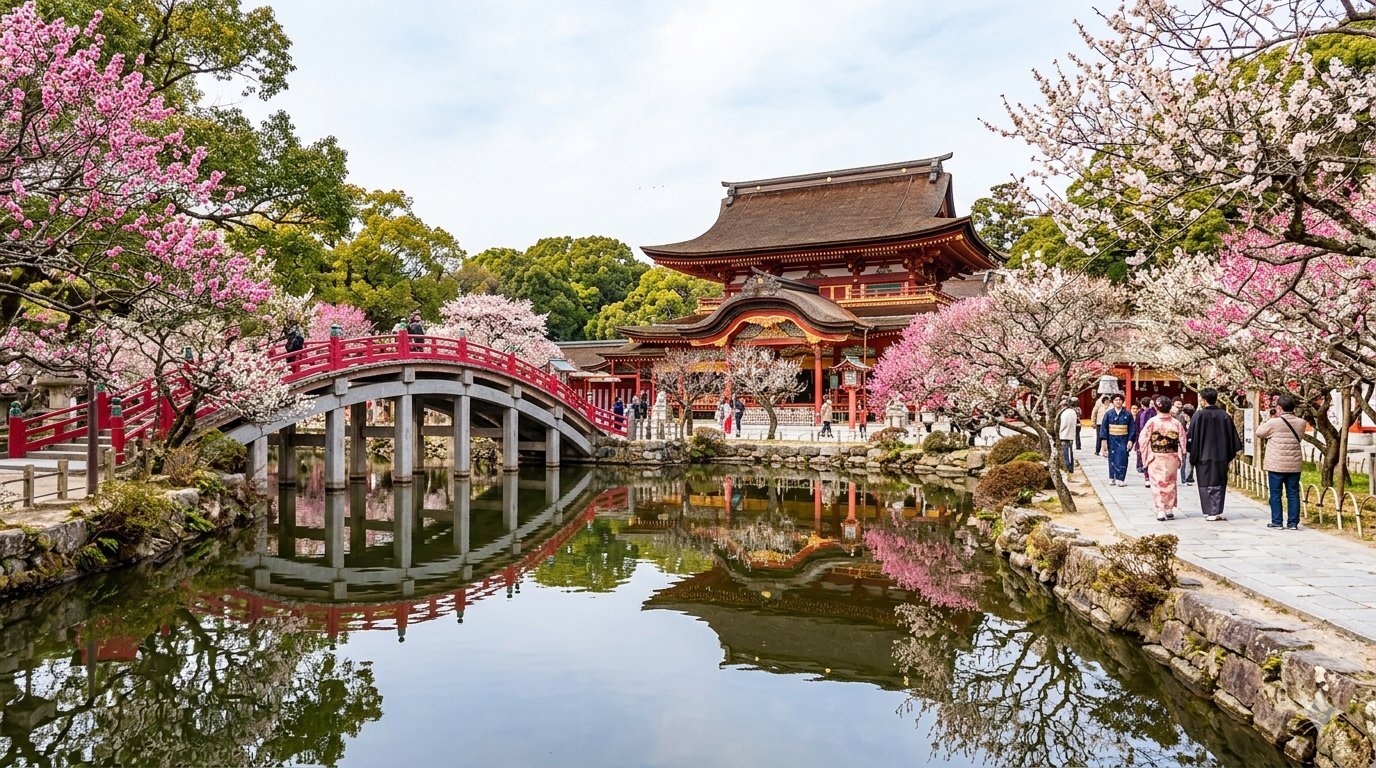
There is a plum tree in the grounds of Dazaifu Tenmangu that, according to legend, flew here overnight from Kyoto. It left because it could not bear to be separated from the man it loved — a scholar-poet who had been unjustly exiled, stripped of everything, and sent to die far from the capital. The man became one of Japan's most revered deities. The plum tree is still blooming.
Dazaifu Tenmangu is the head shrine of around 12,000 Tenmangu shrines across Japan, all dedicated to Sugawara no Michizane — the scholar-statesman who was wronged, died in bitter exile, and then became so feared as a vengeful spirit that the imperial court had no choice but to deify him. As a licensed guide, I find his story one of the most gripping in all of Japanese history, and understanding it transforms a visit to this beautiful shrine in Fukuoka. Here is everything you need to know.
The Man: Japan's Greatest Scholar, Undone by Politics菅原道真の生涯
Sugawara no Michizane (845–903) was, by any measure, one of the most brilliant men of his age. A scholar, poet, calligrapher, and statesman, he rose through the ranks of the imperial court through sheer intellectual ability at a time when such things were almost exclusively determined by birth. By 899, he had reached the position of Minister of the Right — one of the most powerful positions in the government.
Then his enemies moved.
The powerful Fujiwara clan, who had long dominated the court, orchestrated Michizane's downfall through false accusations. In 901, he was stripped of his title and exiled to Dazaifu in Kyushu — a distant posting with no real duties, clearly designed as a death sentence. On the morning he left the capital, he walked out to the plum tree in his garden and composed one of the most beloved poems in Japanese literature:
"Kochi fukaba nioi okose yo ume no hana, aruji nashi tote haru na wasure so."
"Let the east wind blow — carry your fragrance, plum blossoms. Though your master is gone, do not forget the spring."
He died in Dazaifu two years later, in 903, at the age of 58 — cold, hungry, humiliated, and never pardoned.
The God: How Fear Turns a Man Into a Deity怨霊から神へ
What happened after Michizane's death is the part that makes Japan's history truly fascinating.
Within years of his exile and death, disasters began to strike the capital. Lightning killed several high-ranking officials who had been involved in his downfall. A terrible drought was followed by floods and epidemics. Fire destroyed parts of the imperial palace. The crown prince died suddenly.
The court was terrified. These could only be the work of tatari — divine punishment from Michizane's angry spirit. In 919, just sixteen years after his death, a shrine was built on the spot where he was buried in Dazaifu, to enshrine and appease his spirit. His rank was posthumously restored. Then fully promoted. Then he was declared innocent of all charges. Then he was elevated to the highest court rank possible. Then he was deified as Tenman Daijizai Tenjin — the Great Deity of Heaven.
That the court essentially begged a dead man's forgiveness through increasingly elaborate acts of religious appeasement is darkly fascinating — and very Japanese in its pragmatism. Today, Tenjin-sama is the deity of scholarship, learning, and the arts — and Dazaifu Tenmangu draws ten million visitors a year, including vast numbers of students praying before university entrance exams.
The Flying Plum Tree飛梅伝説
The legend of the Tobiume — the "flying plum tree" — says that after Michizane left Kyoto, the plum tree in his garden, missing its master, uprooted itself and flew through the sky overnight to Dazaifu to be with him.
The plum tree standing to the right of the main hall is believed to be that very tree. It still blooms every spring. It is always the first tree on the grounds to flower — before any of the other 6,000 plum trees that fill the shrine grounds in late January through mid-March.
Whether one believes in flying trees is beside the point. The legend captures something real: the depth of grief in that farewell poem, the idea that even the natural world mourns injustice. When you stand before the Tobiume in spring and smell the blossoms, you're participating in a 1,100-year-old act of remembrance.
What to See見どころ
The approach. The roughly 200-meter approach from Dazaifu Station is one of the most charming shrine approaches in Japan — lined with teahouses and shops selling umegae mochi, small rice cakes filled with sweet red bean paste and pressed with a plum-blossom shape. They have been sold here since the Heian period. Try one warm.
The arched bridges. Three bridges cross the pond before the main hall, symbolizing past, present, and future. Cross them slowly.
The bronze ox statues. Several statues of reclining oxen are placed around the grounds. The ox is associated with Michizane — he was born in the year of the ox, died in the year of the ox, and legend says the cart carrying his body stopped at this spot and refused to move. Rubbing the ox's head is said to pass on wisdom and academic success.
The main hall and the current renovation. A note for visitors in 2026: the main hall (honden), originally built in 1591 and designated an Important Cultural Property, is currently undergoing large-scale renovation in preparation for the Shikinen Taisai ceremony in 2027 — the 1,125th anniversary of Michizane's passing. During this period, worship takes place at a temporary hall. The temporary structure itself, designed by contemporary architect Sou Fujimoto with an extraordinary lattice of living plants, is a work of architecture that has attracted considerable attention and is only visible during this period.
The Kyushu National Museum. Up the hill from the shrine, connected by a covered escalator walkway, is the Kyushu National Museum — one of Japan's finest, with extensive exhibits on the history of cultural exchange between Japan and Asia. It pairs beautifully with a shrine visit.
Practical Guide for Visitors実践ガイド
- Getting there
- Dazaifu is easily reached from Fukuoka. Take the Nishitetsu Omuta Line from Fukuoka (Tenjin Station) to Futsukaichi, then transfer to the Nishitetsu Dazaifu Line to Dazaifu Station — about 40 minutes total. From Dazaifu Station, the shrine is a pleasant 5-minute walk along the approach.
- Hours and cost
- Entry to the shrine grounds is free. Open year-round; the grounds are accessible early morning to late evening, with the main buildings open roughly 6:00 am to 8:00 pm (hours vary by season). The Kyushu National Museum charges a separate admission fee.
- Best time to visit
- Late January to mid-March for the plum blossoms — over 200 varieties bloom in a succession of colors and fragrances across 6,000 trees. The shrine is also especially lively during exam season (January–March), when students arrive in large numbers to pray and tie wooden ema votive plaques to the racks. At any time of year, morning visits are quieter.
- Connection to Tenjin Matsuri
- Michizane is the deity honored at Osaka's Tenjin Matsuri, one of Japan's three great festivals — held on the Okawa River every July 24–25 with fireworks and illuminated boats. → Read more in our Japanese Festivals guide.
- Etiquette and keepsakes
- Dazaifu is a Shinto shrine; for a guide to shrine worship and the difference from temple worship, see our Shrine vs Temple Guide. Dazaifu is a wonderful place to receive a goshuin stamp — our Goshuin Guide explains how.
Frequently Asked Questionsよくあるご質問
Who is Sugawara no Michizane, and why is he worshipped?
What is the flying plum tree (Tobiume)?
Is the main hall open in 2026?
How do I get to Dazaifu Tenmangu?
What are the bronze ox statues for?
What should I eat at Dazaifu?
What Justice Looks Like, 1,100 Years Laterむすびに
Sugawara no Michizane died cold, disgraced, and far from home. A century later, his name had been cleared, his rank restored, his spirit enshrined, and his enemies' descendants were coming to beg his blessing before exams. There is something deeply satisfying about that — a reminder that the people who move history are not always the ones who win in the short term.
Stand before the Tobiume in spring, or in front of the temporary hall that holds his spirit today, and you're standing at one of the most human sacred spaces in Japan: a shrine built not in triumph, but in apology. Ten million people a year make that pilgrimage. Most of them are not thinking about 9th-century court politics. They are thinking about exams, about futures, about the people they hope to become. They have chosen to ask for help from a man who was brilliant and wronged and remembered.
When you're ready to explore more of Japan's most meaningful shrines, the guides throughout Sacred Japan will help you find the way.
A shrine built not in triumph, but in apology — Dazaifu Tenmangu, where a plum tree still blooms for a man who was never pardoned in his lifetime.